Brands are handed an iconic space, a captive audience, and only fifteen minutes to do something spectacular. As a studio that builds brand worlds for a living, it’s the time of year we find ourselves most energised. This season gave us plenty to talk about. From the banal surrealism of Marni to the maximalist chaos of Diesel’s 50,000-object archive explosion; AW26 was a season that treated the show set as a creative statement in its own right. Scroll below to find out what caught our eye, and why.
Fashion Week Decoded:The Best Shows From A/W 2026
Updates → Fashion Week Decoded
Choosing StudioXAG's standout shows of the season is never straightforward. Fashion week is the moment when brand expression reaches its most concentrated, most ambitious form.

(Photo Credit: Courtesy of Marni)
(Photo Credit: Courtesy of Marni)
Daniel Wigham, Associate Director of Sustainability + Strategy
“Anybody who knows me knows I love the colour brown. I am fascinated by how such a neutral shade can provoke strong reactions. Some people adore it, others can’t stand it.
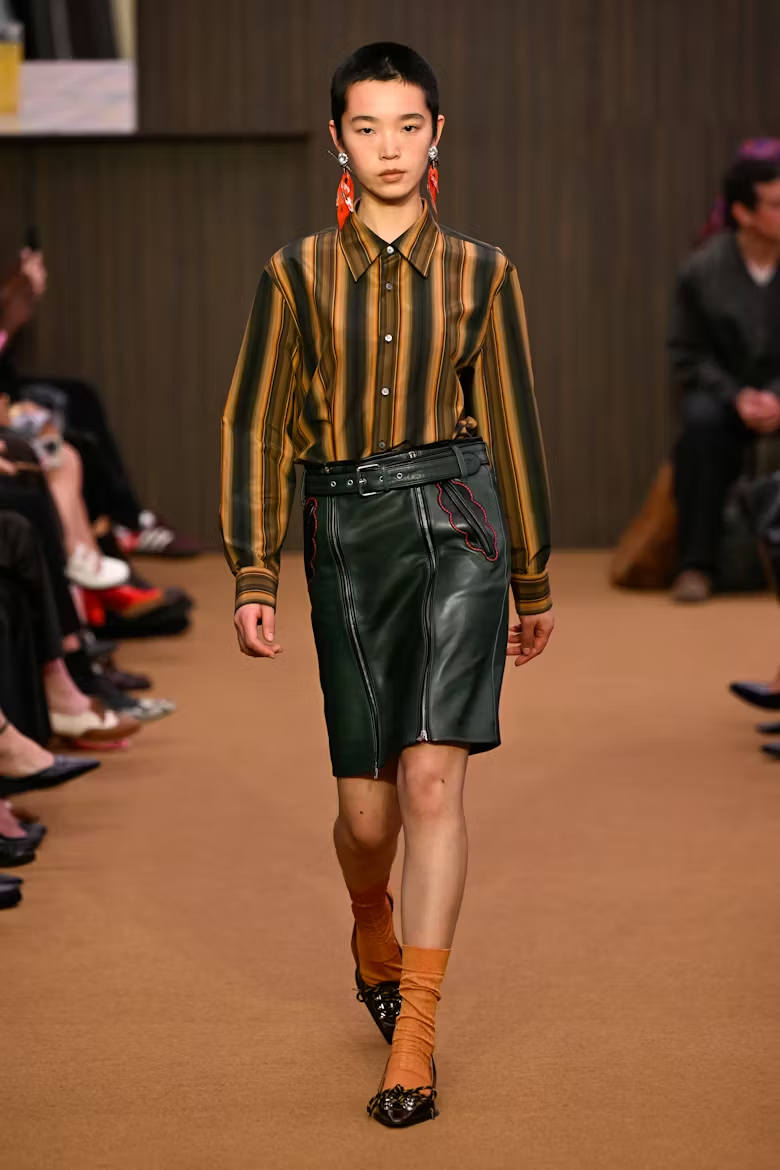
For Meryll Rogge’s debut show at Marni, the Italian design duo Formafantasma leaned directly into that tension. Their set explored the banality of brown and the strange poetry of everyday life.
The space was intentionally unremarkable. Floor to ceiling wooden panelling, beige carpets and grey fabric covered benches created a room that almost asked to be ignored. Yet it had the opposite effect. I couldn’t stop looking at it. Something felt slightly off, like a familiar place reconstructed from memory. Formafantasma described it as “like a room that has been taken apart and reassembled slightly out of order”
Hand-painted canvases were dotted around the space, each depicting small, quotidian scenes. A peeled clementine, an office chair, a lighter. They brought to mind the work of Domenico Gnoli, whose paintings elevated the everyday through meticulous attention to detail. The ordinary, observed closely enough, becomes surreal.
The set ultimately acted as the perfect counterpoint to Rogge’s idiosyncratic collection. It held attention when it needed to, then receded into the background as an ambient stage for the clothes.
Who knew the everyday could be so extraordinary?”

(Photo Credit: Courtesy of Burberry)

(Photo Credit: Courtesy of Burberry)
Gemma Ruse, Founder + Creative Director
“Set in Billingsgate Fish Market, the show unfolded as a nighttime vignette of Tower Bridge, familiar but not literal.
What I loved was the restraint. They didn’t try to recreate the icon, instead borrowing just enough from it, silhouettes, fragments, structural cues, then disrupting it with raw scaffolding. It felt recognisable but unresolved, like a city that’s constantly being rebuilt.
There was confidence in that. Letting it be slightly off and unfinished. The contrast between the recognisable sculptural form of the bridge and the ubiquitous scaffolding.
The puddles, cast in resin, really elevated it for me. A high gloss nod to rain, to gabardine, to the everyday British experience, re-imagined.
The more I think about it, the more it feels like a clear continuation of the thinking Daniel Lee brought in when he first joined Burberry a few years ago. The Norman’s Café takeover was the moment that really landed for me. Iconic in its own way, but so unexpected. Taking something completely ordinary, almost overlooked, and reframing it through a fashion lens.
It felt fresh because it felt true.
We’ve seen that same lens roll out consistently since. Shows, activations, digital. Real places, real texture, a slightly unpolished energy that embraces real British culture and makes it fashion.
That consistency is what makes it resonate so hard. It doesn’t feel like a campaign idea being applied in different places, it feels like a clear point of view.
We talk a lot about reimagining heritage with our clients. The challenge is always the same, how do you make something with deep roots feel current, without losing what made it matter in the first place?
Burberry is a brilliant reminder that it’s not about polishing the past or creating some romanticised version of it. It’s about taking something recognisable and having the confidence to shift it just enough that people see it differently.
That’s what makes it feel modern. More importantly, that’s what makes it feel real.”

(Photo Credit: Courtesy of Louis Vuitton)

(Photo Credit: Courtesy of Louis Vuitton)
Dean Faulkner, Partnerships Director
“Louis Vuitton’s AW26 show felt like stepping into an imagined landscape – part alpine expedition, part futuristic folklore.
Inside the Cour Carrée of the Louvre, Nicolas Ghesquière transformed the historic courtyard into a surreal mountainous terrain. Mossy green peaks and sculptural forms rose around the runway, turning one of Paris’s most iconic spaces into something closer to a dreamlike wilderness.
The collection leaned heavily into the idea of protection and exploration: oversized outerwear, shaggy textures, shearling hats and cocooning silhouettes that felt built for adventure… albeit a very stylish one.
But this wasn’t traditional outdoor gear. Ghesquière filtered those references through Louis Vuitton’s signature blend of craft and futurism. Sculptural heels, richly textured fabrics and unusual accessories gave the collection a real sense of magic – somewhere between mythology and science fiction.
What made the show most compelling was the tension between the wildness of the setting and the precision of the clothes. Nature and technology, past and future, survival and spectacle all collided in the same space.
In a season where many brands looked backwards, Louis Vuitton seemed more interested in imagining the journeys still ahead – and we’re more than ready to lace up our boots and see where the trail leads!”

(Photo Credit: Courtesy of Diesel)

(Photo Credit: Courtesy of Diesel)
Eliza Wright, Senior Account Manager
“What stood out most in the Diesel F/W 26 show was the playfulness (and chaoticness) of the set. Built from more than 50,000 objects pulled from the brand’s archives, it embodied the spirit of “más, más, más” – a crazy landscape that invited the audience to explore rather than simply observe. Toys, inflatables, invitations and memorabilia were scattered throughout the space, encouraging guests to piece together their own backstories.
The installation felt like stepping into Diesel’s universe. Inflatable dolls alongside Santa figurines, branded underwear, plush toys, balloons, confetti and even real pizza slices. It was chaotic, but in the best way – a joyful, and frankly slightly absurd collage of objects that perfectly captured Diesel’s irreverent, anarchic spirit.
What made the set such a standout from an experience lens was the way it sparked curiosity. Instead of a polished, pristine runway, the space felt messy, lived-in and a little dishevelled – perfectly echoing the show’s theme of the “walk of shame.” As creative director Glenn Martens described it, “It’s the moment that maybe we don’t remember. We all had some of them, when you don’t really know where you are when you wake up and wonder, ‘What happened last night?’” he said in a preview. “You had fun and everything is wrongly dressed, but it’s super sexy and hot.” – and I don’t think I could have put it better (and potentially related to) more myself.
There’s something other brands could learn from this approach. Diesel didn’t just build a runway; it created a world. The set felt like something you could wander through mentally, discovering something new, or coming.”

(Photo Credit: Courtesy of Burberry)

(Photo Credit: Courtesy of Burberry)
Amber Dawson, Senior Marketing Manager
“I loved Burberry. I watched it and instantly my mind was cast to myself in London in Winter. I’m heading out to see my friends for a wine. It’s dark, it’s raining, but I’m excited by the cold nights creeping in and the warmth of being indoors. I’m thinking of my winter clothes that I’m ready to take out of storage as Summer passes.
I think what Burberry has been absolutely nailing is their heritage and the culture of being British, what it means to own Burberry. Their 360 marketing approach, all the way from influencers, hello East London Nan, to Olivia Coleman serving in a fish and chip shop, what they do is touch on the memories that each and every one of us can relate to and picture.
Even if you’re not from London, it plays on all of the tropes and feelings that have been immortalised as part of our culture, so it doesn’t matter if you’re from NY or Shanghai, you can feel the London essence of the brand.
And I think that the A/W 2026 runway was just another incredible encapsulation of that feeling, and a feeling is hard to sell, but Burberry has nailed it.”
Sign up to our newsletter below to stay updated with the latest trends.


